Anchor points for fall protection are the core of every professional fall protection system. Whether on power pylons, wind turbines or telecommunications towers – safe work at height is impossible without standard-compliant anchor points. HighStep Systems AG offers the HighStep Anchorpoint, a certified, portable solution that meets the highest standards.
What are anchor points in fall protection?
It is the fixed point to which the personal protective equipment (PPE) system is attached. It is the connection between the person and the structure and, in an emergency, bears the entire weight of the worker – including the dynamic load of a fall. The requirements are therefore very high and clearly regulated by European standards.
They must withstand static and dynamic loads. Depending on the standard and application, loads of at least 12 kN (static) are required. Specific test criteria apply to mobile anchor points according to EN 795, which consider not only tensile strength but also durability and ease of use.
Standards and regulations for anchor points
In Europe, anchor points are regulated by the EN 795 standard. This defines five classes of anchor devices:
- Class A: Fixed anchor points on buildings or structures
- Class B: Mobile anchor points, e.g. portable single anchor devices
- Class C: Horizontal guide rail systems (cable systems)
- Class D: Rail systems (fixed guide rails)
- Class E: Weighted anchoring systems for flat roofs
Class B is particularly important for mobile use on masts and towers. The HighStep Anchorpoint is a standard-compliant product that is tested according to EN 795 Class B and TÜV-certified.
Requirements for professional anchor points
Professional systems must meet the following criteria:
- Certification according to EN 795 and, if applicable, other national standards
- Load-bearing capacity of at least 12 kN static or 6 kN dynamic
- Corrosion-resistant materials (e.g., aluminum, V2A steel)
- Easy and quick installation without special tools
- Compatibility with standard connecting elements (carabiners, etc.)
- Regular review and documentation requirements
The HighStep Anchorpoint
The HighStep Anchorpoint was specifically designed for use on lattice towers, steel profiles, and similar structures. It can be installed without permanently altering the tower structure – ideal for maintenance and assembly teams working at different locations.
Technical features of the HighStep Anchorpoint:
- Certified according to EN 795 Class B
- Maximum load: 15 kN static
- Material: High-strength aluminum with anodized surface
- Mounting: Clamping mechanism, suitable for steel profiles with a flange width of 40 mm or more.
- Weight: approx. 1,2 kg – light and compact for transport
- Compatible with all common PPE systems
When are anchor points mandatory?
In Germany, the obligation to use anchor points and personal protective equipment against falls arises from the DGUV Rule 112-198 as well as the Industrial Safety Ordinance. Wherever there is a risk of falling from a height of 1 m (in practice often from 2 m) and no collective protective measures are possible, personal protective equipment against falls must be used.
For employers, this means they are obligated to provide suitable anchor points with proven load-bearing capacity. Homemade or non-certified solutions are not permitted. Only standard-compliant, regularly inspected anchor points protect against employment law consequences in the event of an accident.
Regular inspection of anchor points
According to DGUV Regulation 3 and the manufacturer's instructions, anchor points must be inspected at least once a year by a qualified person. In case of intensive use or after a fall, an immediate special inspection is required. HighStep Systems AG recommends regularly documenting all tests in a test log.
The following aspects are assessed during the examination:
- Visual inspection for damage, corrosion and deformation
- Functional test of the clamping or fastening mechanism
- Testing the supporting structure for sufficient strength
- Verification of the labeling and declaration of conformity
Integration into existing fall protection systems
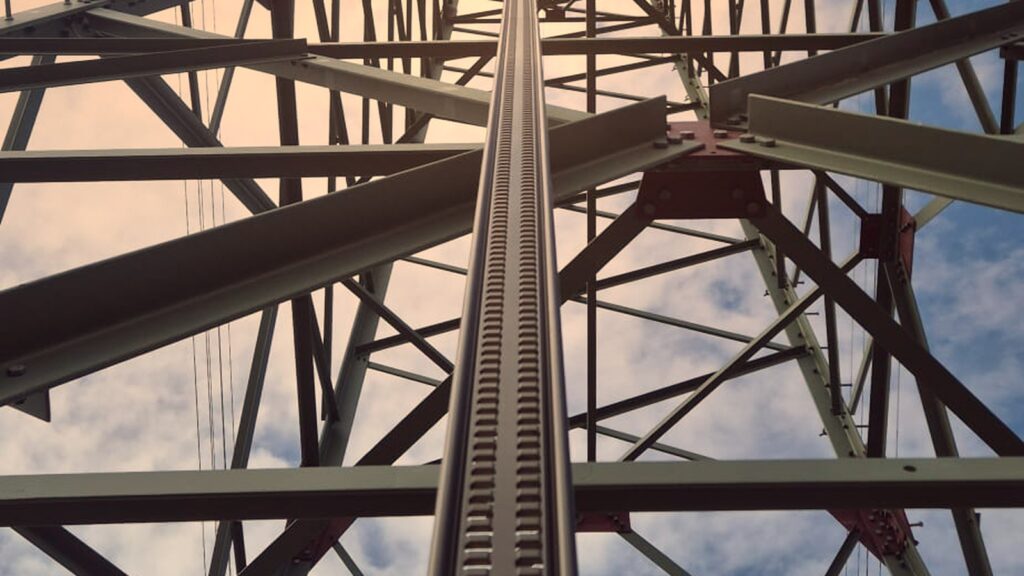
The HighStep Anchorpoint integrates seamlessly into existing PPE concepts. Combined with the HighStep rail (vertical fall arrest system), it creates a comprehensive safety system for masts of all types. The fall arrest rail and portable anchor point complement each other perfectly: the rail secures the ascent, while the Anchorpoint enables safe work on-site without additional infrastructure.
Conclusion: Safety begins with the correct anchor point
Certified anchor points are not an option, but a legal requirement – and a matter of responsibility towards every employee working at height. With the HighStep Anchorpoint, you get a portable, TÜV-certified solution that combines the highest safety standards with ease of use.
Contact us now: Our team of experts will be happy to advise you on your specific use case. Contact HighStep Systems AG still today – for safe work at heights that knows no compromises.