Why the HighStep system should always be included in the planning of new power lines
Power lines and Overhead line pylons Building a ladder is expensive and complex – every investment is carefully considered. It is therefore all the more astonishing that an innovative climbing system such as HighStep only around 1-2% of construction costs but brings enormous safety and efficiency gains. This rail-based system (permanently installed aluminum rail + mobile lift or pedal device) enables maintenance teams to access lofty heights quickly, safely, and ergonomically. In view of increasing demands – from a shortage of skilled workers due to demographic change to stricter occupational safety regulations – a simple calculation shows: The small additional investment for HighStep is worthwhile eternity In the following, we will examine the facts-based Cost-benefit ratio and why HighStep at Pipeline construction has become the new standard.
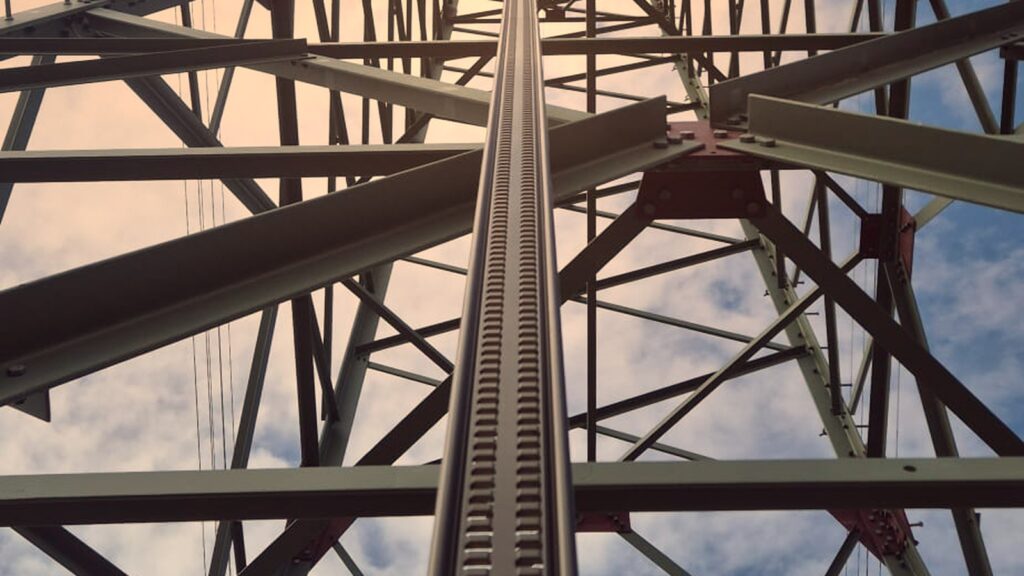
A technician uses the HighStep climbing system on a high-voltage pylon. The permanently installed rail in the center of the pylon allows for safe, rapid ascent via lift or pedal device – without the physical strain and risk of falling associated with conventional ladders.
Minimal additional costs in the billion-euro power line project
Especially in the construction of modern power lines, the choice of a safe and efficient access system plays a crucial role, because investments multiply in the long term. The dimensions of Power line construction are enormous: kilometers of FreileitungsbauProjects often cost millions to billions. For example, investments for new 380 kV lines in Germany are around €1-2 million per kilometer, depending on the terrain and the number of pylons. With such sums, additional equipment per pylon is hardly significant. HighStep can be used for the construction of a new high-voltage pylon for about 1-2% of construction costs be installed – a fraction of the budget.
In other words, if a pylon costs, for example, €200.000, the HighStep system adds only around €2.000–€4.000. This system consists of a permanently mounted rail (maintenance-free and durable) plus either the HighStep Lift (electric personnel lift) or HighStep Easy (pedal-operated climbing device). The rail is anchored directly into the pylon structure, enabling comfortable, central access. At grid operator 50Hertz, for instance, new pylons are equipped with HighStep rails in the center as standard – because the additional costs amount to only about 1% of the new construction project and pay for themselves in the long run. Particularly economical: the climbing shoes or lift only need to be purchased once and can be used on all equipped pylons – eliminating the need for duplicate investments. For large power line projects, this means lower material costs, less downtime, and significantly shorter project timelines.
For illustration, the following table lists typical Cost and benefit effects a new mast construction without vs. with HighStep on:
| Aspect | Conventional mast (without HighStep) | Mast with HighStep system |
|---|---|---|
| Construction costs per mast (Example) | 100% (e.g. €200.000) | ~101-102% (approx. €202.000) |
| Access system | Ladder/crampons + PPE (standard) | Integrated aluminum rail + Lift/Easy |
| Time for ascent (≈30 m) | ~20-30 minutes (manually with backup) | ~3 minutes (by lift) |
| Personnel expenses per use | 2 people (climber + belay) | 1 person (secured in the lift) |
| Risk of falling | Increased (climbing = risk of falling, fatigue) | Minimized (through permanent rail protection) |
| Access maintenance | Regular inspection of ladder & PPE | Rail maintenance-free – no inspection intervals |
| Lifespan & Upgrade | Ladder is subject to wear and tear, no upgrade | Rail durable; compatible with new devices (future-proof) |
| follow-up costs (Accidents, breakdowns) | Significant: consequences of accidents, days lost, etc. | Low: Fewer accidents, hardly any downtime costs |
Table: Comparison of investment and key benefits of new electricity pylon construction using the HighStep system.
Occupational safety and ergonomics: Protecting employees, preserving know-how
A key argument for HighStep is the Work SafetyMaintenance work at heights of 30-70 m on exposed masts poses significant risks: wind, rain, ice, heavy tools, and strenuous climbing increase the risk of accidents. Conventional climbing solutions (stirrups, ladders with fall arresters) cannot completely eliminate falls – a moment of inattention can have fatal consequences. HighStep, on the other hand, offers maximum fall protection: The technician and his equipment remain permanently secured to the rail, making slipping or falling virtually impossible. human tragedies avoided and employees remain healthy and motivated.
Add to that ErgonomicsClimbing ladders places enormous strain on muscles and joints, especially in light of the demographic change In a world where maintenance teams are getting older on average, it is crucial to design workplaces that are age-appropriate. The HighStep system drastically reduces physical exertion. No more endless climbing on narrow rungs, instead, either a self-locking pedal (when Easy) or a relaxing lift ride. This saves energy and extends the Availability of experienced specialistsFor example, a crane operator in Switzerland was able to safely climb back into his crane after shoulder surgery thanks to an installed HighStep rail. – something that wouldn't have been possible with a conventional ladder. Companies benefit twofold: Valuable expertise stays on board longer, and employee satisfaction increases when dangerous climbs are a thing of the past.
Last but not least, HighStep also improves the Vandalism protectionFreestanding masts often need to be secured against unauthorized climbing. While ladders or climbing irons provide manipulation points, the HighStep rail cannot be used without suitable climbing equipment – unauthorized persons cannot even get up. Overall, all these safety aspects also result in Cost savingsEvery avoided accident saves considerable direct and indirect costs (continued wage payments, insurance premiums, replacement staff, project delays, etc.). HighStep prevents such outages and increases the operational reliability of power grids.
Efficiency in everyday maintenance: Faster, with less personnel and equipment
For network operators, efficiency is just as important as safety. The HighStep system reduces ascent and descent times from 20–30 minutes to just a few minutes – a huge advantage for long routes and numerous pylons per maintenance round. Technicians reach their working level faster and without physical strain, enabling more service calls per day.
Especially along long Power linesFor sections of track that are spread over many kilometers, HighStep significantly reduces logistical and personnel burdens. Staffing requirements also decrease: instead of two or three people, often one specialist can safely ascend, as the HighStep lift provides continuous safety support and tools can be carried directly along. This simplifies deployment planning and allows for parallel teams working on different sections. Overall, HighStep leads to shorter maintenance windows, fewer network outages, and significantly lower operating costs.
Practical proof: HighStep as the new standard in pipeline construction
50Hertz's experience clearly shows that a modern riser system is essential for new buildings. Power lines HighStep has long been a practical and economical standard solution. The advantages described are not theoretical, but are already confirmed by leading network operators. One example is 50Hertz: Following an EU-wide tender, the operator rated HighStep as the safest and most economical solution. Since 2018, hundreds of pylons have been retrofitted; new projects are already using HighStep as standard. This large order demonstrates that permanently installed access aids are now considered a proven standard in practice.
HighStep is also gaining ground internationally. Swissgrid (Switzerland) and TenneT (Netherlands/Germany) have implemented the system in their networks, as has the State Grid Corporation of China. Worldwide, mehrere tausend HighStep installations are in operation, which demonstrates the maturity and reliability of the technology. Pipeline construction-Specialists in the industry – whether Power line constructionCompanies such as Omexom, EQOS, LTB, or engineering partners such as Electron – are equally faced with the task of implementing projects safely and efficiently. Given the successes with major network operators, it is to be expected that HighStep will also be involved in more and more tenders for the Power Gridsindustry. The system has evolved from an innovative newcomer to a Best Practice which sets new standards for safety and productivity in modern mast and route projects.
Sustainable complete solution instead of individual lift
HighStep is not a standalone device, but a complete fall protection system. The permanently installed rail remains in place for the entire lifespan of the mast, is corrosion-resistant, and maintenance-free. The lift and pedals are mobile, used only when needed, and protected against theft and weather. The modular design ensures compatibility with future generations of equipment.
The combination of rail, climbing equipment, and integrated fall protection creates a well-designed, comprehensive solution. Planning, installation, and training are seamlessly integrated, and maintenance teams can use the same technology on different systems. HighStep is therefore a long-term infrastructure upgrade – not just a temporary access aid.
Small investment, big impact – HighStep always thinks ahead
For the coming Power linesFor future generations, HighStep will therefore become an essential component of modern infrastructure planning. The facts are clear: HighStep offers a exceptional cost-benefit ratioAn additional investment of around 1-2% during the construction phase enables enormous savings and improvements over the entire life cycle of the plant. Work Safety means fewer accidents and breakdowns, better Ergonomics maintains the performance of employees and increases the attractiveness of the profession in the face of the shortage of skilled workers. Maintenance processes and reduced personnel costs increase operational efficiency and reduce operating costs in the long term. And all this through a System, which integrates seamlessly into the mast structure and requires virtually no additional maintenance.
For Decision makers in the energy and pipeline construction industry, the conclusion is: For every new construction project in Power line construction HighStep should be planned from the beginning. Benefit arguments The advantages – from security to time savings to future-proofing – far outweigh the low costs. As the practical examples show, HighStep has already established itself and proven itself in leading companies. The question is no longer ob, rather why not – there is no reasonable reason to forego this improvement if you think long-term.
Include HighStep in your next project now – we’ll be happy to advise you!
Are you currently planning a new Overhead line, a high-voltage pylon or would you like to future-proof your existing systems? Then take the opportunity to learn more about HighStep Systems to inform. Contact us Contact us today for a free consultation and learn how the HighStep system can be integrated into your project to maximize safety and efficiency. Our experts are ready to work with you to find the optimal solution – so your investment pays off from day one. Steigenberger You now switch to the technology of Future in Pipeline construction!